ORIGINAL ARTICLE
MACEDO, Lívia Maria Pinto [1], SILVA, Américo Junior Nunes da [2]
MACEDO, Lívia Maria Pinto; SILVA, Américo Junior Nunes da. Pedagogical potential of geometric representations in teaching fractions: trends and gaps in the proceedings of the Encontro Baiano de Educação Matemática. Revista Científica Multidisciplinar Núcleo do Conhecimento. Year 11, Issue 01, Vol. 01, pp. 117-143. January 2026. ISSN: 2448-0959. Access link: https://www.nucleodoconhecimento.com.br/education/the-encontro-baiano, DOI: 10.32749/nucleodoconhecimento.com.br/engenharia-civil/fibra-de-aco-reciclada
ABSTRACT
This article, the result of a final graduation thesis, investigates how geometric representations have been utilized in teaching fractions across the last three editions of the Encontro Baiano de Educação Matemática (EBEM), as well as the impacts of these practices on the teaching-learning process. This is a qualitative research study that conducted a systematic mapping of the proceedings, identifying contributions, trends, and gaps related to the theme. The results show that, although few papers directly address the teaching of fractions, there is a significant presence of proposals that utilize manipulatives and different forms of visual representation, highlighting the potential of these resources for building fractional thinking. It is concluded that visual, playful, and manipulative approaches expand students’ conceptual understanding and foster more meaningful mathematical learning.
Keywords: Fractions, Geometric Representations, Concrete Materials, EBEM, Mathematics Education.
1. INTRODUCTION
Mathematics education, particularly regarding the contents of fractions and geometry, has been highlighted by various studies as a field that presents challenges for both teachers and students in basic education (Rogeri; Pietropaolo; Prado, 2018; Almouloud et al., 2004). Among the frequently reported difficulties, key issues include the complexity of the concepts, a tendency toward fragmentation in the teaching process, and the need for stronger connections with concrete, everyday school situations.
In the case of fractions, research emphasizes that properties such as the density of rational numbers—evident to teachers but often challenging for students—represent significant obstacles to learning, requiring approaches that foster the gradual construction of this knowledge (Rogeri; Pietropaolo; Prado, 2018; Weber; Fachin, 2015). Regarding geometry, studies indicate that difficulties are also associated with a shortage of pedagogical materials, a lack of resources that enable concrete practices, and the logical complexity students face when dealing with this content (Lobato; Andrade, 2019; Bissolotti; Titon, 2022).
In this context, the integration of fractions and geometric representations emerges as a promising possibility to make teaching more visual, accessible, and meaningful, promoting an integrated understanding of mathematical concepts.
The educational paths of many students have been marked by significant challenges in the field of geometry, especially during Basic Education—a stage in which this area of mathematics is, generally and still, under-explored in the school environment (Stiegelmeier; Marthos; Bressan, 2019). The absence of a solid conceptual foundation can intensify feelings of alienation and difficulty when facing new topics, highlighting the need for more consistent and meaningful pedagogical work with geometry right from the early years of schooling. Such an approach can help students develop the ability to visualize and understand mathematical concepts in a more concrete and integrated manner (Stiegelmeier; Marthos; Bressan, 2019; Penteado; Pereira; Brandt, 2020).
Given the recurring difficulties in teaching fractions and geometry, particularly concerning the conceptual understanding of these contents, the following question guides this investigation: What do the publications in the last three editions of the Encontro Baiano de Educação Matemática (EBEM) reveal about the use of geometric representations integrated with concrete materials, and how can this work impact the teaching-learning process of fractions?
Thus, the general objective of this investigation is: to understand what the publications in the last three editions of the Encontro Baiano de Educação Matemática (EBEM), in the years 2021, 2023, and 2025, reveal about the use of geometric representations integrated with concrete materials and the impacts of these practices on the teaching-learning process of fractions.
This article constitutes an adapted version of the final graduation thesis entitled As figuras geométricas para o ensino e a representação das frações [Geometric figures for teaching and representing fractions]¹, presented on December 10, 2025, as a partial requirement for obtaining a Bachelor’s Degree in Mathematics Education (Licenciatura em Matemática) from the Universidade do Estado da Bahia. With a view to expanding the dissemination of the results and contributing to the advancement of the field, the work was revised, updated, and restructured to fit the format and requirements of a scientific article.
2. METHODOLOGICAL PROCEDURES
The methodology adopted for this study falls within the qualitative approach, focusing on the construction of a mapping. According to Detroz, Hinz, and Hounsell (2015), systematic literature mappings are employed in situations where the topic is broad or there is limited available evidence; they offer an overview of the field of study, allowing for the identification of research trends or gaps to be explored.
In this context, it is worth highlighting that documents, as is the case with scientific publications, represent a relevant source of evidence that supports the author’s assertions, providing information that arises from a specific context and reveals aspects unique to that very scenario (Lüdke; André, 1986).
The choice of EBEM as the source for surveying pedagogical practices is justified by the relevance the event has achieved in the educational landscape of Bahia throughout its history. Recognized as the largest gathering in the field within the State, EBEM has consolidated itself, over more than three decades, as a privileged space for sharing experiences, research, and reflections that significantly contribute to strengthening Mathematics Education.
The analysis of the material gathered in a mapping, such as the one proposed here, enables a comprehensive view of the productions already carried out in the field, offering relevant insights to build a consistent foundation for this investigation. According to Morosini and Fernandes (2014), developing a state-of-the-knowledge study allows for mapping already consolidated ideas, pointing out gaps, indicating under-explored subthemes, and revealing significant silences in the literature.
Thus, in line with the general objective outlined in the introduction, the following specific objectives were established:
i) Map the productions presented in the last three editions of EBEM that address the use of geometric representations linked to concrete materials for the teaching of fractions;
ii) To map the studies presented in the last three editions of EBEM that address the use of geometric representations integrated with concrete materials for teaching fractions;
iii) To analyze the methodological approaches, instructional resources, and pedagogical conceptions present in the selected papers, as well as the impacts of the reported practices on the teaching-learning of fractions;
Regarding the first specific objective, the complete conference proceedings corresponding to the delimited period were consulted and analyzed. The choice of these editions is justified because they cover the publications from the last five years (2021 to 2025), thus gathering the most recent and updated material available from the event. Initially, titles, abstracts, and keywords were examined to identify papers potentially related to the object of investigation. Subsequently, we conducted a full-text reading of the selected papers, ensuring the relevance of the analyzed publications and the consistency of the mapping. The editions of the event that were mapped:
Table 1 – Mapped editions of EBEM

The following inclusion criteria were established for this study: papers that directly address the teaching of fractions; studies that utilize geometric representations; and works that discuss or report the use of concrete/manipulative materials in the classroom related to the aforementioned content. As exclusion criteria, the following were defined: studies that do not engage with Basic Education; and papers that only mention fractions or geometry without deepening methodological strategies.
In this mapping, we concentrated our analysis on Scientific Communications (CC) and Experience Reports (RE), as we understand that these modalities can present both research results and narratives of practices developed in real classroom contexts, directly linking the object of investigation to pedagogical experiences—a central aspect of this study.
Following the initial mapping and the full-text reading of the RE and CC that link directly to the theme of this thesis, and in line with the second specific objective, we proceeded to organize the collected data into summary tables. The purpose of these tables is to systematize the contributions and limitations pointed out by the authors of the analyzed papers, enabling the identification of trends, recurrences, and gaps in the examined literature.
Regarding the third specific objective, a qualitative analysis was conducted. This analysis was carried out based on a detailed reading of the full texts, emphasizing the adopted methodological strategies, the materials used, and the integration between geometric representations and the teaching of fractions.
3. ANALYSIS AND DISCUSSION
3.1 TEACHING FRACTIONS: A MAPPING OF ACADEMIC PAPERS IN THE LAST THREE EDITIONS OF EBEM
In the last three editions of EBEM, held in 2021, 2023, and 2025, a total of 483 papers were identified, consisting of 240 RE and 243 CC. From this dataset, 64 publications focused on geometry; five dealt specifically with the teaching of fractions; and six addressed the teaching of fractions integrated with geometric representations. These last six constitute the central object of this article and, for this reason, were selected for analysis.
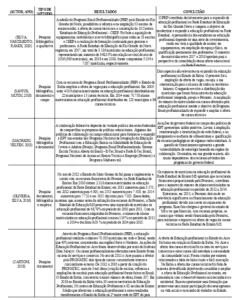
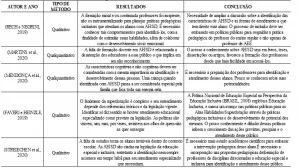
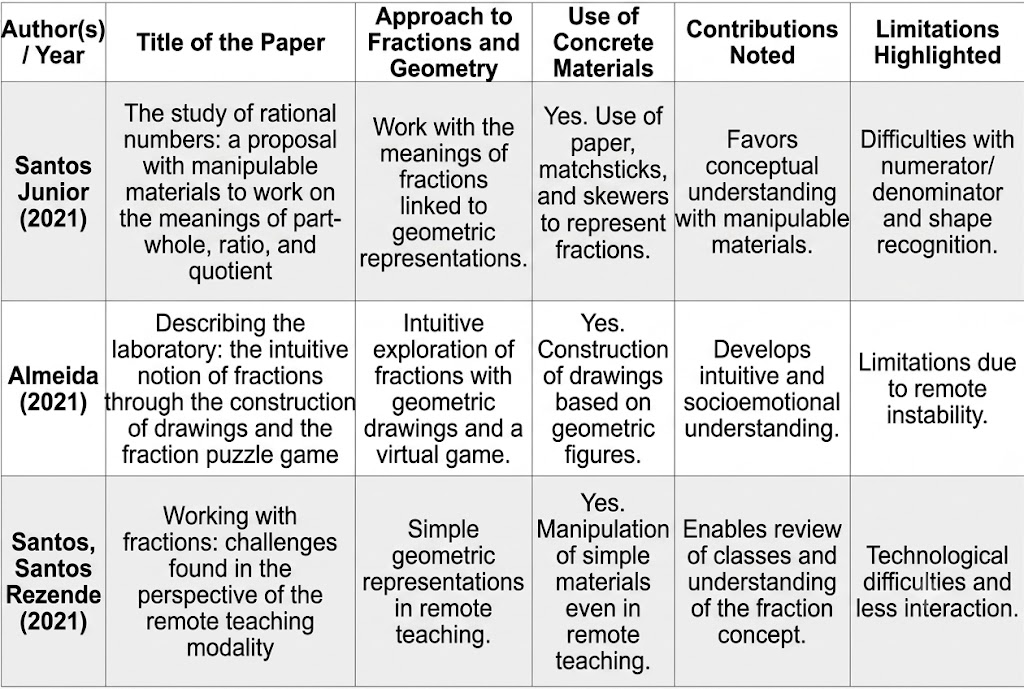
The papers selected based on the previously defined inclusion and exclusion criteria were organized into summary tables to allow for a more detailed and systematic analysis of the identified studies. The table presented below, Table 2, brings together a general systematization of these publications, highlighting the approach to fractions and geometry in each study, the use of concrete materials, and the contributions and limitations pointed out by the authors, thereby supporting reflection on the advancements and challenges still present in the field of Mathematics Education.
Table 2 – General systematization of the mapped papers

3.2 CONCEPTIONS OF CONCRETE AND MANIPULATIVE MATERIALS
Upon a closer examination of these papers, it was found that all of them propose the use of concrete and manipulative materials, highlighting the importance of these resources in the mathematics teaching-learning process. The described experiences demonstrate that the use of visual representations and manipulatives fosters the conceptual understanding of fractions, allowing students to establish relationships and making learning more dynamic and meaningful. This became evident, for example, in the text by Daltro (2025), which highlights that the practice of constructing concrete materials contributes to the development of logical thinking and enables students to mobilize the knowledge acquired in the classroom within real-world situations.
Thus, we chose to initially analyze how these works conceive manipulative and/or concrete materials. We understand that the way such resources are defined, selected, and mobilized by teachers reveals pedagogical conceptions that can either foster or limit the construction of meaning by students. Furthermore, understanding these conceptions allows for the identification of convergences and divergences between the literature in the field and the practices described in the papers, as well as the recognition of the potential contributions of these materials to the development of more visual, active, and meaningful learning in the study of fractions integrated with geometric representations.
Among the six papers that comprise the investigated corpus, two explicitly use the term manipulative material, one uses the expression concrete material, and the others resort to broader designations, such as pedagogical tools or games. This terminological heterogeneity reveals not only distinct conceptual understandings but also different ways of conceiving the role of these materials in the teaching-learning process.
As highlighted by Lucena (2017), instructional material can be understood as any resource that assists in the mediation of knowledge, while manipulative instructional material refers specifically to objects that allow for tactile exploration, construction, decomposition, and the concrete visualization of mathematical ideas—essential characteristics for working with fractions and geometric figures.
Beyond the distinctions between manipulative and concrete materials, the papers also evidence conceptions that broaden the understanding of resource use in teaching fractions, especially when considering games and other pedagogical tools as powerful mediators of learning, as structural devices for mathematical thinking capable of promoting argumentation, experimentation, and decision-making (Silva et al., 2025; Novaes et al., 2025)—fundamental elements for the development of proportional reasoning and fractional understanding.
From this perspective, games and pedagogical tools are conceived as resources that mobilize multiple representations, stimulate student engagement, and foster collaborative interactions that enrich the knowledge construction process. Thus, by integrating different types of materials and strategies, the analyzed papers reveal a more comprehensive understanding of the formative potential of these resources, recognizing that the teaching of fractions integrated with geometric representations can be significantly strengthened when approaches are diversified and when the investigative, visual, and interactive nature of pedagogical practices is valued (Silva et al., 2025; Novaes et al., 2025).
It is observed that some of the analyzed papers lack a more precise theoretical foundation regarding the type of material used and its pedagogical implications. In some cases, although the authors mobilize resources that fall under the notion of manipulative materials, there is no conceptual explicit definition of this term, which hinders the comprehension of the theoretical and methodological framework guiding the reported practices. There is, therefore, a need for greater conceptual precision in research/reports within the field, so that discussions on materials, their potentials, and limitations can be deepened and contribute more consistently to the field of Mathematics Education.
Furthermore, it was found that the six analyzed proposals contribute to the construction of knowledge about fractions by presenting differentiated methodologies that stimulate active student participation and problem-solving in diverse contexts.
However, the publications also point out persistent difficulties related to the interpretation and application of fraction concepts, often arising from external factors, such as limited instructional time, large class sizes, and the lack of individualized support. As Sampaio (2012) highlights, it is unlikely that a teacher will be able to fully develop Mathematics in a way that reaches all students using a single methodological proposal, which reinforces the importance of diversifying pedagogical strategies and resources to meet the different needs of learners. According to the mapped papers, these practices contribute to strengthening conceptual understanding, making the teaching process more dynamic and contextualized (Santos Junior, 2021; Almeida, 2021; Santos; Santos; Rezende, 2021; Daltro, 2025; Silva et al., 2025; Novaes et al., 2025).
3.3 METHODOLOGICAL APPROACHES USED IN TEACHING FRACTIONS WITH GEOMETRIC REPRESENTATIONS
The identified methodological approaches reveal a predominance of proposals that place the student at the center of the teaching-learning process, prioritizing actions that stimulate active participation, experimentation, and investigation. In the analyzed papers, knowledge is constructed through the manipulation of materials, the production of different representations, and engagement in mathematical games, indicating a significant departure from traditional lecture-based logic. In its place, practices emerge that value collective construction, guided exploration, and interaction with instructional resources, so that the relationships established by students—both with the learning objects and within the school environment—become essential elements for developing meaning in the study of fractions integrated with geometric representations (Santos Junior, 2021; Almeida, 2021; Santos; Santos; Rezende, 2021; Daltro, 2025; Silva et al., 2025; Novaes et al., 2025).
In this sense, it is worth highlighting that manipulative materials, as discussed by Lucena (2017), constitute tools that allow students to explore concepts through touch, construction, and the deformation of geometric objects, as well as to perform calculations concretely, fostering the development of logical-mathematical reasoning, which is essential for real-world problem-solving. This perspective aligns with contemporary curriculum guidelines because, as pointed out by Novaes et al. (2025), the integration of games, manipulative materials, and curricular work contributes to enriching students’ mathematical background, stimulating critical and reflective thinking, and the application of knowledge to real situations. Furthermore, the very way the content is presented exerts a direct influence on learning, given that, as indicated by Silva et al. (2025), the structuring of proposals determines whether students will develop a more comprehensive or more limited understanding of the topic. Thus, the analyzed practices reveal a pedagogical movement that seeks to make the teaching of fractions more meaningful, visual, and participatory (Santos Junior, 2021; Almeida, 2021; Santos; Santos; Rezende, 2021; Daltro, 2025; Silva et al., 2025; Novaes et al., 2025).
We identified a strong presence of theoretical-practical and experimental activities within the studies (Daltro, 2025; Almeida, 2021). Table 2 reveals that most proposals involve constructing objects (plane figures, drawings, fraction calculators) or using games (fractional tic-tac-toe). This shows a recurring effort to transform abstract fraction concepts into concrete experiences, which converges with studies defending the importance of manipulation for the meaningful learning of fractional concepts.
Another important aspect identified in the mapped papers concerns methodological diversification, although it is still marked by limitations resulting from the context in which they were produced (Santos Junior, 2021; Almeida, 2021; Santos; Santos; Rezende, 2021; Daltro, 2025; Silva et al., 2025; Novaes et al., 2025). It is observed that some proposals were developed in person, while others took place in a remote format, especially in the papers published in 2021 (a period directly impacted by the Covid-19 pandemic). This scenario required teachers, pre-service teachers, and teaching residents to reorganize their practices, adapting materials, strategies, and resources to the possibilities offered by the virtual environment. As studies in the field highlight, the sudden transition to remote teaching placed educators and students before a modality for which many were unprepared, demanding methodological reorganization and new forms of pedagogical mediation (Santos; Santos; Rezende, 2021).
Regarding the instructional resources and manipulative materials used in the analyzed papers, there is a strong predominance of simple and easily accessible materials, such as paper, matchsticks or barbecue skewers, drawings, and games built by the students themselves (Almeida, 2021; Daltro, 2025; Novaes et al., 2025). This aspect reveals a conception of teaching-learning that values the use of low-cost and widely available resources, allowing for greater teaching autonomy and enabling the implementation of the proposals in different school contexts, including those marked by structural limitations.
3.4 CONTRIBUTIONS AND LIMITATIONS OF THE ANALYZED PRACTICES
Upon a closer examination of the analyzed pedagogical practices, the use of games stands out as a privileged strategy for the visualization and understanding of fractions. In particular, two papers resorted to the ‘fractional tic-tac-toe’ game, whose recurrence reveals that teachers recognize games as a pedagogical experience capable of mobilizing different registers of representation, fostering comparisons between fractions, and stimulating the production and interpretation of mathematical meanings (Silva et al., 2025; Novaes et al., 2025). The adoption of this strategy demonstrates that potentially playful practices increase student engagement, foster active participation, and contribute to learning (Silva; Souza; Cruz, 2020; Suzart; Silva, 2020).
The literature also reinforces this understanding by indicating that playfulness, when intentionally utilized, not only sparks student interest, enriches peer relationships, and revisits previously studied content, but also enables the construction of new knowledge, constituting a powerful methodological resource for teaching mathematics (Silva; Souza; Cruz, 2020). Thus, by recognizing the pedagogical value of playful learning, the analyzed papers reaffirm the importance of integrating mathematical games as part of the student’s developmental process.
Although less frequent, the use of digital resources, such as virtual games and digital graphic productions, was also identified, appearing in studies such as the one by Almeida (2021). Even if isolated, this initiative reveals an initial movement toward inserting digital technologies into the teaching of fractions, pointing to new approach possibilities. The presence of these resources highlights promising paths for diversifying forms of representation and expanding students’ interactions with mathematical concepts, enhancing learning through different languages and technological mediums.
Furthermore, by incorporating digital elements, these papers align with contemporary trends in Mathematics Education, which advocate for the integration of Information and Communication Technologies (ICT) as a pedagogical resource to renew practices and foster student participation. In this regard, Weber and Fachin (2015) emphasize that ICT holds great relevance in the educational process, as it not only modifies the traditional form of communication but also strengthens the teacher-student relationship.
Regarding the pedagogical conceptions identified in the analyzed papers, a broad and multifaceted understanding of the fraction concept is observed. The publications value different meanings associated with this content, ranging from the part–whole relationship (Santos Junior, 2021) to the diversity of possible representations (Silva et al., 2025), encompassing operations, properties, and, in a special way, integrations with geometry (Daltro, 2025). Such an approach reveals a pedagogical conception aligned with the conceptual field of fractions, avoiding simplistic reductions that limit students’ conceptual development.
Another relevant aspect is that all analyzed studies established some form of relationship between these two domains—fractions and geometric representations—recognizing that visualization plays a fundamental role in the construction of meaning. This trend highlights the importance of approaches that integrate different fields of mathematics, especially when intending to foster the understanding of proportional relationships, fractional structures, and equivalences. This perspective dialogues with reflections already present in the literature, which highlight the central role of visual and spatial experience in the development of mathematical thinking.
As Toledo and Toledo (1997) point out, when starting their school life, children are already in contact with the space and geometric shapes surrounding them, so that exploring this concrete reality constitutes a privileged instructional resource. Thus, the integration between fractions and geometry, observed in the analyzed papers, reinforces the relevance of practices that use geometric representations as a support for conceptual construction in teaching fractions.
Finally, the pedagogical conceptions evidenced in the analyzed papers point to a strong emphasis on learning mediated by visualization and the manipulation of mathematical objects. In all publications, it is assumed that students need to see, touch, construct, and model fractions so that concrete experience fosters the elaboration of abstract concepts. This methodological orientation reinforces the understanding that developing mathematical thinking requires more than the memorization of rules and procedures: it requires meaningful situations that enable exploration, experimentation, and hypothesis testing by the students themselves.
In this sense, it highlights the importance of providing opportunities to manipulate different materials, allowing students to build concepts through integrated sensory and cognitive experiences, as pointed out by Toledo and Toledo (1997), who argue that direct contact with objects and representations fosters conceptual understanding and reduces the mechanical use of algorithms.
As Santos Junior (2021) highlights, employing diversified methodological strategies, especially those incorporating concrete materials, facilitates the learning of mathematical content and promotes an environment more conducive to active student participation. Thus, the body of evidence points out that practices based on manipulation and visualization constitute promising paths for teaching fractions, especially when integrated with geometric representations, strengthening understanding and expanding students’ mathematical background (Santos Junior, 2021; Almeida, 2021; Santos; Santos; Rezende, 2021; Daltro, 2025; Silva et al., 2025; Novaes et al., 2025).
Regarding the impacts of the analyzed practices on the teaching-learning of fractions, the papers evidence significant advancements in students’ conceptual understanding. Overall, progress was observed in the identification, representation, and interpretation of fractions, especially in recognizing different registers and meanings associated with this content. The results indicate that the use of manipulative materials played a central role in this process, fostering conceptual construction in a more concrete and meaningful way.
Studies such as the one by Santos Junior (2021) highlight that such resources enable students to formulate hypotheses, test ideas, and develop different meanings of rational numbers, strengthening their understanding. Similarly, Daltro (2025) shows that students who previously faced difficulties were able to actively participate in activities and perform calculations with greater confidence, demonstrating that proposals based on concrete materials have a positive and direct impact on mathematics learning in Basic Education.
Despite the advancements identified, significant difficulties persist regarding the use of algorithms and the execution of formal operations with fractions. The analyzed papers reveal that many students still encounter obstacles when performing calculations with this type of number, especially when they need to transfer the understanding built through visual and manipulative representations into symbolic notation. This scenario highlights that conceptual learning, though essential, does not automatically guarantee procedural mastery, which demands more intentional and articulated interventions by the teacher.
Such difficulties are not new and reflect a problem widely discussed in the Mathematics Education literature. As Toledo and Toledo (1997) point out, the teaching of fractions is frequently introduced rigidly, with a heavy emphasis on rules and algorithms, without adequate reference to the underlying meanings of the concept. According to the authors, after the initial stage of defining fractions, textbooks and many school practices quickly move on to teaching operations through standardized algorithms, which can compromise deep understanding and foster the mechanical use of procedures. This analysis reinforces the need for pedagogical practices that integrate visualization, manipulation, and formalization, ensuring that students understand how and why operations work, rather than just how to execute them.
Another point that deserves highlight refers to the central role of teacher guidance in developing the analyzed proposals. In some studies, such as the one by Daltro (2025), it was observed that the lack of direct monitoring of all students limited the effectiveness of the activities, especially in large classes or in tasks that demanded individualized support. This finding reinforces the understanding that the teacher plays an essential role in the pedagogical mediation process, since it is up to them to plan, guide, and promote experiences that spark student interest, articulating content and materials meaningfully, as Santos (2016) already argues when defending that educators are protagonists in creating stimulating and intentionally guided learning environments.
Furthermore, the literature points out that no single methodological approach is capable of fully addressing all learning needs, especially regarding complex content like fractions. In this regard, Sampaio (2012) emphasizes that it is unlikely for a teacher to reach all students through a single methodology, making it necessary to diversify strategies and engage in constant reflection on their practice, with a view to facilitating the teaching-learning process. Thus, the findings of this study suggest that proposals based on manipulative materials, games, and visualizations can produce significant results, but depend directly on adequate structural conditions and a responsive, attentive, and continuously reflective teaching performance.
3.5 TRENDS, RECURRENCES, AND GAPS IN THE ANALYZED PAPERS
Table 3 presents a general systematization of the mapped and analyzed papers, with the purpose of highlighting identified recurrences and gaps. The studies were organized into four main categories: (i) Teaching of Fractions; (ii) Geometric Representations; (iii) Concrete Materials; and (iv) Teacher Education. This categorization was developed based on the understanding that categorizing implies performing a classification operation on the constituent elements of a dataset, through differentiation and regrouping processes guided by previously defined criteria, so as to gather under a common heading the elements that share similar characteristics.
Table 3 – Trends, recurrences, and gaps

It can be observed that the evidence repeatedly identified in the analyzed papers points to the need to explore diverse ways of representing fractions, moving beyond an approach restricted solely to geometric representations. This broadening of perspectives fosters an understanding of the multiple meanings that the fraction concept can assume, helping students construct a wider and more contextualized view of the subject. In this sense, Santos Junior (2021) highlights that rational numbers constitute one of the fundamental contents of mathematical knowledge, being addressed throughout basic education, which reinforces the importance of varied approaches to consolidate this knowledge.
When analyzing the identified gaps, it is noted that many students still face difficulties in understanding the fraction concept and applying it adequately in different contexts. This limitation may be associated with a lack of internalization of the diverse forms of fraction representation, which compromises the articulation among symbolic, concrete, and visual thinking (Santos Junior, 2021; Almeida, 2021; Santos; Santos; Rezende, 2021; Daltro, 2025; Silva et al., 2025; Novaes et al., 2025).
In this regard, Sampaio (2012) emphasizes that, to achieve better results in the educational process, teachers need to adopt different methodological approaches and continuously reflect on their practices, seeking to improve them to facilitate learning. Thus, we reinforce the need for pedagogical practices that value the use of diversified resources and innovative strategies aimed at constructing consistent meanings regarding the topic of fractions.
When addressing the approach to geometric representations, the significant importance of visual and spatial representations as pedagogical tools in teaching fractions becomes evident. These representations allow students to comprehend abstract concepts through the visualization and manipulation of figures, making the learning process more concrete and intuitive. Geometry, in this context, offers a privileged pathway for the construction of meaning by enabling students to relate the fraction concept to areas, parts of figures, and proportions.
However, it is observed that studies deeply exploring this relationship between geometry and fractions methodologically are still scarce, often limiting the use of figures merely as illustrative resources. As Cruz (2022) highlights, geometry—since the contributions of Descartes—establishes essential connections with algebra, allowing the representation of figures through mathematical expressions and relationships. This integration between different fields of knowledge reinforces that geometric and arithmetic contents should not be treated in isolation, but rather integrated, to foster a more consistent logical development and more enjoyable, meaningful learning for the student.
Regarding the use of concrete materials, the data collection revealed a high recurrence of this approach in the analyzed papers, highlighting the pedagogical potential that these resources possess to foster the learning of fractions. The use of manipulative materials contributes to making teaching more dynamic, participatory, and meaningful, stimulating student involvement and promoting a more concrete understanding of mathematical concepts (Santos Junior, 2021; Almeida, 2021; Santos; Santos; Rezende, 2021; Daltro, 2025; Silva et al., 2025; Novaes et al., 2025).
Nevertheless, it is observed that there is still a need to critically reflect on which materials are most suitable for each educational context, since the effectiveness of these resources depends on their selection and pedagogical experience. In this sense, Lucena (2017) highlights that the selection of instructional materials must be carried out carefully and specifically, taking into account the particularities of each class and the proposed learning objectives. Thus, rethinking the use and intentionality of concrete materials becomes essential to enhance the fraction teaching-learning process.
Within the scope of teacher education, the analyzed papers reinforce the need to promote differentiated methodological proposals for teaching fractions. The authors highlight that, despite the relevance of this content for understanding various mathematical concepts, many students still demonstrate resistance, insecurity, and disinterest toward the subject. This reaction is often a consequence of prior experiences marked by poorly contextualized methodologies or the absence of resources that foster conceptual understanding. It is common for students to express fear, the belief that ‘they are not capable’ of understanding the content, or even to give up when faced with difficulties, which reinforces the importance of more welcoming and meaningful teaching practices, leading us to conjecture about the importance of adequate teacher education for this work (Santos Junior, 2021; Almeida, 2021; Santos; Santos; Rezende, 2021; Daltro, 2025; Silva et al., 2025; Novaes et al., 2025).
As observed by Novaes et al. (2025), in activities involving fractions, it is noticeable that many students experience difficulties in verbally expressing their knowledge regarding different fractional representations. The looks of astonishment and hesitation reveal that these students’ contact with the theme, most of the time, has been limited to superficial and low-exploratory approaches (Santos Junior, 2021; Almeida, 2021; Santos; Santos; Rezende, 2021; Daltro, 2025; Silva et al., 2025; Novaes et al., 2025). In this sense, teacher education needs to encompass the development of pedagogical competences that allow for the re-signification of fraction teaching, incorporating more dynamic strategies, concrete materials, and visual representations, so that students can build a solid and confident understanding of this important mathematical concept.
Finally, a significant lack of specific training initiatives aimed at preparing teachers to teach fractions and use geometric representations is evident. This gap is directly reflected in pedagogical practices, which often prove to be limited and fragmented, hindering students’ construction of learning. The absence of teacher professional development that promotes conceptual and methodological mastery of these contents contributes to the maintenance of traditional practices centered on memorization and the repetition of procedures.
In this regard, Santos (2016) underscores that the contemporary educational context demands new teaching-learning dynamics capable of overcoming the fragmented and decontextualized model still present in many classrooms. The author advocates that teaching must be associated with dialogue, participation, and creation, recognizing the active role of the teacher as a mediator in the knowledge construction process. Thus, it becomes urgent to rethink initial and continuing teacher education so that it encompasses practices fostering the use of geometric representations and concrete materials in teaching fractions, thereby strengthening teaching autonomy and effective student learning.
4. FINAL CONSIDERATIONS
The teaching of fractions constitutes one of the pillars of mathematical background in basic education, requiring students to understand multiple meanings, develop the ability to establish conceptual relationships, and acquire skills that go beyond the mastery of operational techniques. The analyses carried out throughout this study evidenced that, despite the complexity of this content, the use of geometric representations, manipulative materials, and visual approaches fosters learning.
This investigation allowed for the identification of how different practices integrate the teaching of fractions with geometric representations. The mapping revealed important contributions, such as the centrality of active learning, the constant presence of concrete materials, and the emphasis on visualization as a mediating strategy. At the same time, it highlighted recurring gaps, related primarily to students’ difficulties in understanding the meanings of fractions, moving between distinct registers of representation, and applying knowledge to contextualized situations—challenges widely discussed in the literature of the field.
Finally, it is recognized that this study does not close the discussion regarding the possible integrations between fractions and geometric representations. On the contrary, it opens pathways for future investigations to widen the scope of the analysis, deepen the use of digital technologies, and explore other methodological approaches. Thus, it reaffirms the commitment that mathematics teaching can, and must, be a space for meaningful experiences, where theory and practice meet to promote a more human, critical, and transformative learning process.
REFERENCES
ALMEIDA, Diego Góes. Descrevendo o laboratório: a noção intuitiva de frações por meio da construção de desenhos e do jogo Enigma das Frações. In: ENCONTRO BAIANO DE EDUCAÇÃO MATEMÁTICA, 19., 2021, Salvador. Anais […]. Salvador: SBEM-BA, 2021. Disponível em: https://proceedings.science/ebem/ebem-2021/trabalhos/descrevendo-o-laboratorio-a-nocao-intuitiva-de-fracoes-por-meio-da-construcao-de?lang=pt-br. Acesso em: 9 out. 2025.
ALMOULOUD, Saddo Ag.; et al. A geometria no ensino fundamental: reflexões sobre uma experiência de formação envolvendo professores e alunos. Revista Brasileira de Educação, Rio de Janeiro, n. 27, p. 94–108, 2004. Disponível em: https://www.scielo.br/j/rbedu/a/xzRGKxDRJ6XS4ZXxLnBTkFL/?format=pdf&lang=pt. Acesso em: 9 set. 2025.
BISSOLOTTI, Mariane Lima; TITON, Flaviane Predebon. Diagnóstico sobre as dificuldades de aprendizagem da geometria no ensino médio e os potenciais elementos facilitadores. Contraponto, Blumenau, v. 3, n. 4, p. 1–15, jul./dez. 2022. Disponível em: https://publicacoes.ifc.edu.br/index.php/contraponto/article/view/2746/2319. Acesso em: 16 set. 2025.
CRUZ, Keyte Rocha da. A importância da geometria no processo ensino-aprendizagem: uma alternativa pedagógica para o ensino da matemática. Rebena – Revista Brasileira de Ensino-Aprendizagem, v. 4, 2022. Disponível em: https://rebena.emnuvens.com.br/revista/article/view/47. Acesso em: 15 out. 2025.
DALTRO, Guilherme Cardoso. Calculadora de frações: relato sobre o uso de material concreto nas aulas de Matemática. In: ENCONTRO BAIANO DE EDUCAÇÃO MATEMÁTICA, 17., 2025, Salvador. Anais […] Salvador: Sociedade Brasileira de Educação Matemática – Regional Bahia, 2025. p. 1–12. Disponível em: https://www.sbembrasil.org.br/eventos/index.php/ebem/article/view/852. Acesso em: 6 out. 2025.
DETROZ, Juliana Patrícia; HINZ, Mauro; HOUNSELL, Marcelo da Silva. Uso de pesquisa bibliográfica em Informática na Educação: um mapeamento sistemático. Revista Brasileira de Informática na Educação, v. 23, n. 1, 2015. Disponível em: https://www.researchgate.net/publication/281264478. Acesso em: 10 set. 2025.
LOBATO, Lydia Fernandes.; ANDRADE, Gustavo Oliveira de. Desafios do ensino de geometria no ensino médio. 2019. Trabalho de Conclusão de Curso (Especialização em Docência do Ensino de Matemática) – Instituto Federal do Piauí, Piauí, 2019. Disponível em: http://bia.ifpi.edu.br:8080/jspui/handle/123456789/582. Acesso em: 13 abr. 2023.
LUCENA, Regilania da Silva. Laboratório de ensino de matemática: materiais didáticos manipuláveis e suas potencialidades para o ensino-aprendizagem da matemática no LEM. 2017. p. 25–40. Disponível em: https://educapes.capes.gov.br/bitstream/capes/429642/2/Laborat%C3%B3rio%20de%20Ensino%20de%20Matem%C3%A1tica.pdf. Acesso em: 15 out. 2025.
LÜDKE, Menga; ANDRÉ, Marli. Métodos de coleta de dados: observação, entrevista e análise documental. In: FAUSTINI, L. (org.). Pesquisa em educação: abordagens qualitativas. São Paulo: EPU, 1986. p. 25–44.
MOROSINI, Marília Costa.; FERNANDES, Cleoni Maria Barboza. Estado do conhecimento: conceitos, finalidades e interlocuções. Educação por Escrito, Porto Alegre, v. 5, n. 2, p. 154–164, jul./dez. 2014. Disponível em: https://revistaseletronicas.pucrs.br/porescrito/article/view/18875. Acesso em: 8 set. 2024.
NOVAES, Mariane dos Santos; et al. A utilização do Jogo da Velha Fracionário na aprendizagem de frações. In: ENCONTRO BAIANO DE EDUCAÇÃO MATEMÁTICA, 21., 2025, Salvador. Anais […]. Salvador: SBEM-BA, 2025. v. 1, n. 21, p. 1–12. Disponível em: https://www.sbembrasil.org.br/eventos/index.php/ebem/article/view/872/873. Acesso em: 9 out. 2025.
PENTEADO, Daniele Regina.; PEREIRA, Ana Lúcia.; BRANDT, Célia Finck. Geometria no ensino fundamental: das exigências legais às práticas cotidianas. Revista Paranaense de Educação Matemática, v. 8, n. 16, p. 48–81, 2020. DOI: 10.33871/22385800.2019.8.16.48-81. Disponível em: https://periodicos.unespar.edu.br/rpem/article/view/6143. Acesso em: 27 out. 2025.
ROGERI, Norma Kerches de O.; PIETROPAOLO, Ruy César.; PRADO, Maria Elisabette Brisola Brito. Conhecimentos de professores dos anos iniciais do ensino fundamental sobre os números racionais e sobre seu ensino na educação básica. JIEEM, v. 11, n. 3, p. 253–260, 2018. Disponível em: https://jieem.pgsscogna.com.br/jieem/article/view/7059/4520. Acesso em: 17 jul. 2025.
SAMPAIO, Ricardo. Abordagens metodológicas no ensino de matemática. Monografia (Trabalho de Conclusão de Curso) – Universidade Estadual Paulista, São José do Rio Preto, 2012. Disponível em: https://www.ibilce.unesp.br/Home/Departamentos/Matematica/abordagens-metodologicas-no-ensino-de-matematica.pdf. Acesso em: 4 jun. 2025.
SANTOS, Cintia Melo. Reflexões sobre metodologias para o ensino da matemática à luz da Educação Matemática. In: SEMINÁRIO SUL-MATO-GROSSENSE DE PESQUISA EM EDUCAÇÃO MATEMÁTICA, 10., 2016. Anais […] Disponível em: https://periodicos.ufms.br/index.php/sesemat/article/view/1737. Acesso em: 4 jun. 2025.
SANTOS, Clebisson Pereira dos.; SANTOS, Joel Pereira.; REZENDE, Luciano de Jesus Santos. Trabalhando com frações: desafios encontrados na perspectiva da modalidade de ensino remoto. In: ENCONTRO BAIANO DE EDUCAÇÃO MATEMÁTICA, 19., 2021, Salvador. Anais […] Salvador: SBEM-BA, 2021. Disponível em: https://proceedings.science/ebem/ebem-2021/trabalhos/trabalhando-com-facoesdesafios-encontrados-na-perspectiva-da-modalidade-de-ensin?lang=pt-br. Acesso em: 6 out. 2025.
SANTOS JUNIOR, Moises Dias. O estudo dos números racionais: uma proposta com materiais manipuláveis para trabalhar os significados parte-todo, razão e quociente. In: ENCONTRO BAIANO DE EDUCAÇÃO MATEMÁTICA, 21., 2021. Anais […] Disponível em: https://proceedings.science/ebem/ebem-2021/trabalhos/o-estudo-dos-numeros-racionais-uma-proposta-com-materiais-manipulaveis-para-trab?lang=pt-br. Acesso em: 6 out. 2025.
SILVA, Américo Júnior Nunes da.; SOUZA, Ivanete dos Santos.; CRUZ, Idelma Souza da. O ensino de Matemática nos anos finais e a ludicidade: o que pensam professora e alunos? Educação Matemática Debate, v. 4, n. 10, p. 1–19, 2020. DOI: 10.24116/emd.e202018. Disponível em: https://www.periodicos.unimontes.br/index.php/emd/article/view/1672. Acesso em: 13 jun. 2025.
SILVA, Maria Estela da.; et al. Explorando diferentes representações de frações por meio de uma atividade lúdica. In: ENCONTRO BAIANO DE EDUCAÇÃO MATEMÁTICA, 17., 2025. Anais […] Salvador: SBEM–BA, 2025. p. 1–12. Disponível em: https://www.sbembrasil.org.br/eventos/index.php/ebem/article/view/858/885. Acesso em: 6 out. 2025.
STIEGELMEIER, Elenice Weber.; MARTHOS, Vilsiele Cristina.; BRESSAN, Glaucia Maria. O contexto da geometria no âmbito escolar: concepções e implicações na formação docente. REMAT, v. 5, n. 1, p. 25–40, 2019. DOI: 10.35819/remat2019v5i1id3167. Disponível em: https://periodicos.ifrs.edu.br/index.php/REMAT/article/view/3167. Acesso em: 27 out. 2025.
SUZART, Leonardo Araújo.; SILVA, Américo Junior Nunes da. Ensino de geometria nos anos finais do ensino fundamental: um mapeamento das produções no estado da Bahia. Revista Baiana de Educação Matemática, v. 1, p. 1–22, e202002, 2020. Disponível em: https://www.revistas.uneb.br/index.php/baeducmatematica/article/view/e202002. Acesso em: 14 set. 2025.
TOLEDO, Marília; TOLEDO, Mauro. Didática de matemática: como dois e dois. 1. ed. São Paulo: FTD, 1997.
WEBER, Cristina Back; FACHIN, Maria Paula G. Ensino de frações utilizando o GeoGebra. 2015. Disponível em: https://lume.ufrgs.br/bitstream/handle/10183/134133/000983786.pdf. Acesso em: 22 jul. 2025.
AUTHOR INFORMATION
[1] Undergraduate Student in Mathematics at the State University of Bahia. ORCID: https://orcid.org/0009-0001-8107-4794. Lattes Curriculum: http://lattes.cnpq.br/1218391850439060.
[2] Advisor. PhD in Education from the Federal University of São Carlos. ORCID: https://orcid.org/0000-0002-7283-0367. Lattes Curriculum: http://lattes.cnpq.br/5104791370402425.
Authors’ contributions:
Lívia Maria Pinto Macedo: Conception, planning, analysis, interpretation, and drafting of the paper.
Américo Junior Nunes da Silva: Conception, planning, analysis, interpretation, and drafting of the paper.
MATERIAL INFORMATION
Conflict of interest:
None.
Acknowledgments and Funding:
None.
Note:
Use of Artificial Intelligence (ChatGPT Go) regarding the paper for reviewing grammatical issues and ABNT standards. However, all searches for content, classification of article quality, as well as the analysis and intellectual production were independently conducted by the authors. The authors assume full responsibility for the material.
Copyright and License Information:
This is an Open Access article distributed under the terms of the Creative Commons Attribution License, which permits unrestricted use, distribution, and reproduction in any medium, provided the original author and source are credited.
The names and addresses entered in this journal site will be used exclusively for the stated purposes of this journal and will not be made available for any other purpose or to any other party.
- ISSN (online version): 2448-0959.
- Creative Commons License: This work is licensed under a Creative Commons Attribution 4.0 International License.
Publication History:
Manuscript received: December 19, 2025.
Peer-reviewed and accepted: December 24, 2025.
Edited manuscript approved by authors: January 09, 2026.