ORIGINAL ARTICLE
VIANA, Arnóbio Araújo [1]
VIANA, Arnóbio Araújo. The harmonizing operation (H) and its inverse melody operation (M). Revista Científica Multidisciplinar Núcleo do Conhecimento. Year. 07, Ed. 03, Vol. 03, p. 144-171. March 2022. ISSN: 2448-0959, Access link: https://www.nucleodoconhecimento.com.br/mathematical-olympiads/melody-operation
The lack of a mathematical operation to explain the interactions of waves, especially between the sound waves of musical notes, was the problem that guided the construction of this article. In this context, the objective of this research, aiming at a better visualization of a simple sound wave, was to demonstrate operations developed by the author of this material, composed of three most important characteristics to Music: amplitude
Keyword: Harmonization, Melody, Harmony, Melody.
At the beginning of 2006, the author of this material developed Operation Harmonization for the harmonic groupings of sound waves of the harmonies of musical notes and Operação Melodiação, for the melodic groupings of sound waves of his melodies.
The problem that motivated the construction of this material and the development of these operations was the lack of a mathematical operation to explain the interactions of waves, especially between the sound waves of musical notes. In this context, the objective is to demonstrate operations developed by the author of this material, composed of three most important characteristics of Music: amplitude
For the development of this, initially, it was considered that only for sound waves and, later, in general, for any other element with or without vibration, the physical phenomenon of “Wave Superposition” occurs, where, in the encounter between two equal waves, there is an increase in the resulting amplitude between them (SILVA, n.d.).
Using the expression
When they meet at a common point
Evaluating the result of this interference phenomenon, it was observed that at the meeting point p of the superposition between these two waves, in addition to the existing algebraic sum between their amplitudes
It was also concluded, in this initial analysis, that these two operations, addition between amplitudes and union between frequencies, in addition to forming the result of this phenomenon, also integrate a single mathematical operation, characterized by this Operational Duality. This explains the simultaneous emission of waves of musical notes, whose sound effect is called Harmony. Therefore, the name of Operation Harmonization or operation H was admitted, adopting a left slant bar (\) as its mathematical symbol, called the H operator
Consequently, its inverse operation was developed, in which the sound waves leave the superposition condition and pass to the uninterrupted condition, where the final time of one wave is equal to the initial time of the next wave
Generally speaking, when two or more rhythmic periodic waves
The more waves of these types there are in this operation, the more frequencies will be joined
Operation Harmonization and its Harmony between three distinct and rhythmic periodic waves:
In the Harmonization operation between sound waves, specifically of rhythmic musical notes, where normally the harmony of a main musical chord is formed by a triad or three notes, with different frequencies
Assuming that these waves are equal
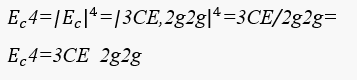
Due to this phenomenon and considering this rounding, the harmony of this operation was formed only by calculating the union operation between its frequencies . Therefore, for this simplified result, it is not necessary to know the sound intensity
Some H operations with musical notes identified by their numbers are described below, where the notes of A, B, C, D, E, F and G are respectively A, B, C, D, E, F, G, taking based on the work of Guest (2020, p. 33 to 41):
1) Calculate the harmony between musical notes:
2) Calculate the harmony between musical notes:
3) Calculate the harmony between musical notes:
Note: in this study, it is defined that a harmony is named with its frequencies in ascending order and tonic accent on the last frequency. For example,
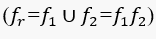
Unitary Harmony is the result of the H operation between two or more equal periodic waves
This type of harmony can appear, in this space-time, that there is only one periodic wave in its structure, however, two or more equal periodic waves coexist in it, occupying the same space-time, constituting a Harmonic Unitary Set capable of generating, in a its unitary structure, two or more continuous equal periodic waves in a new spacetime
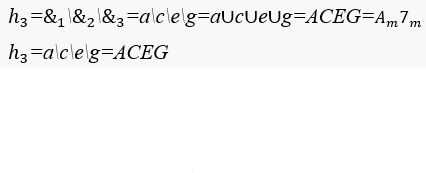
In this way, two or more unitary harmonies will only be equal
1) Unison harmony between four rhythmic waves, with equal frequencies and different amplitudes.
Graphic 1: Unison harmony
Graph 1 shows the time interval
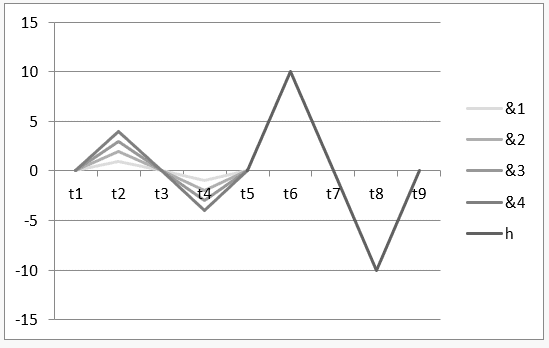
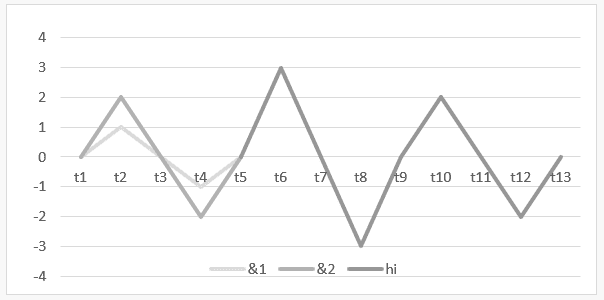
2) Harmony with destructive interference between two rhythmic periodic waves:
Graphic 2: Harmony with destructive interference
The time interval
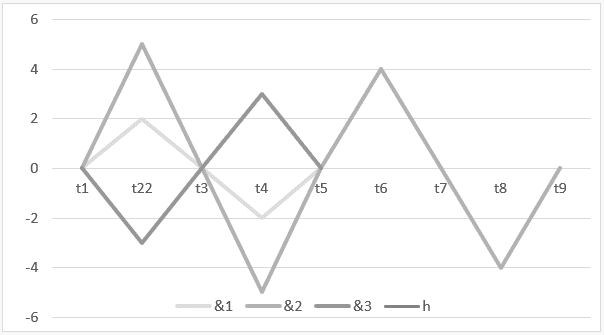
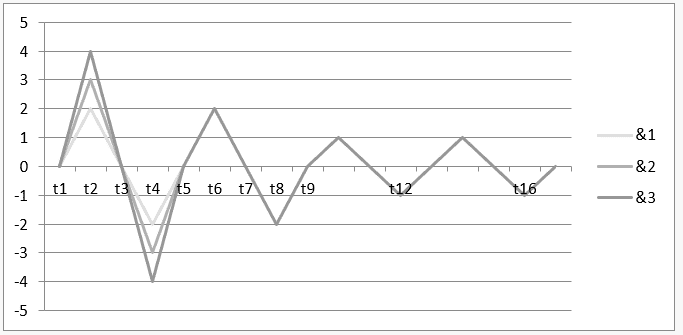
3) Constructive and destructive harmony between three waves:
Graphic 3: Harmony with constructive and destructive interference
The time interval
4) Harmony between five waves of musical notes equal to the G note, two seconds long.
Empty harmony is the result of the operation H between a wave and its opposite wave or the operation between several waves and their opposite waves
This kind of harmony
In this way, two empty harmonies will only be equal if their characteristics and quantities are equal. Whatever the empty harmony
Therefore, the result of the harmony between any neutral element and an active element is the active element itself
When this harmony is formed by sound waves from opposite musical notes, the sound amplitude is completely eliminated from its frequency
When this harmony is formed by luminous vibrations, the luminosity of the amplitude of its frequency is totally eliminated
1) Harmony between two waves:
Graphic 4: Empty harmony of
The time interval
2) Harmony between musical notes: C, one second long, with equal and inverse amplitudes
Note: Empty Harmony is a place in space-time where there is a thought that nothing exists in it, however it may be filled with non-perceivable vibrations.
Unstable Harmony is the result of the H operation between two or more arrhythmic periodic waves or with different durations
The greater the number of these arrhythmic waves in this operation
1) Unstable harmony between two arrhythmic waves:
Graphic 5: Unstable harmony of
The time interval
2) Harmony between two arrhythmic musical notes:
3) Unstable harmony between three arrhythmic musical notes:
Graphic 6: Unstable harmony of
The time interval
4) Unstable harmony between three arrhythmic musical notes with equal frequencies:
5) Unstable harmony with empty harmony between two waves:
Graphic 7: Unstable Harmony with empty harmony of
The time interval
6) Harmony between two G musical notes with equal amplitudes in opposite phases, one lasting three seconds and the other lasting two seconds
When two or more numeric constants
Any cluster formed by a combination of Combinatorial Analysis is considered the result of an H operation between these elements
1) Harmony between numerical constants 1 and 1
2) Harmony between numeric constants 1 and -1
3) Harmonies between numeric constants
4) Harmonies between numeric constants
5) Harmonies between numeric constants
6) Harmonies between a numeric constant
Note: the harmony of the operation H between any numerical constant “n” and any neutral element
The Melody operation or M, is the inverse operation of Harmonization, because after the end of the duration of a harmony, the periodic vibrations that were in superposition, pass the condition of Uninterruption, that is, they form a continuity between their spaces-times, where the end time of one duration is equal to the start time of the next duration
Therefore, when two or more periodic vibrations
Normally, musical notes in an M operation have amplitudes in positive phases, however, if there is a note with amplitude in negative phase, it can be modulated to positive phase, as the frequency remains the same, producing the same sound effect in the formed melody
However, this negative sign can remain in the musical note cipher and in the melody result with a dot over it
The Musical Pause is a musical note with zero sound frequency amplitude, represented by a negated zero
The Binary Rhythmic Module in
When a musical note starts in one measure and ends in another without losing its sound continuity, its continued cipher receives an apostrophe in the next measure, for example,
1) Rhythmic Distribution:
2) Major Arrhythmic Distribution
3) Minor Arrhythmic Distribution
The Algebra of Vibrations is nothing more than Algebra with at least one of the Harmonization or Melody operations in its expression.
Even if it does not present any of these operations, it can be modulated for the Algebra of Vibrations, through the available wave modules, such as: the Melodic Module
Through the standard rhythm modules
given to the expression:
Replacing the variables
the melodic module
The normally arrhythmic result is modulated to any rhythm
Note: The operation M between a numerical constant “n” and a sound constant “x”, is equal to the melody of the sound constant “n” times
Melodic expression module
Comment: choosing a rhythm is optional and, if the ternary rhythm module was chosen, the last note would be divided with a part in the penultimate measure and another continuous in the last measure, identified with an apostrophe in its cipher
When substitution occurs in the melodic module, both of sound and numerical constants, the resulting melodic expression is called interactive, as it includes a physical dynamics as a function of the numerical constant, as shown in the example below.
given to the expression
Note: the numerical value three (3) in the first bar represents any physical action, for example: counting from one to three in triple time and then playing the indicated melody in the following measures
When in the melodic module the constants are all numeric, the result is a numeric melodic grouping, as shown in the example below.
The harmonic sound module
Note: the operation H between a numerical constant “n” and a sound constant “x” is equal to the unison harmony of the sound constant
When the replacement of both sound and numerical constants occurs in the harmonic module, the resulting harmonic expression is called interactive, as it includes a physical dynamics as a function of the numerical constant, as shown in the example below.
The harmonic sound value of the expression is calculated
Note: the numerical value three (3) in the single bar represents any physical action, for example: counting from one to three in triple time while performing the indicated harmony
When in the harmonic module the constants are all numerical, the result is a numerical harmonic grouping, as shown in the example below.
The composite module
The composite sound value of the expression is calculated
When the substitution of both sound and numerical constants occurs in the composite module, the resulting composite sound expression is interactive, as it includes a physical dynamics through the numerical constant, as shown in the example below.
The composite sound value of the expression is calculated
When in the composite module only numerical constants are replaced, the result is a numerical composite grouping, as shown in the example below.
With the development of the Harmonization operation, some scientific hypotheses raised by the author of this material emerged, in this study, for some natural phenomena.
The phenomenon of wave-particle duality of light, where light has the characteristic of either a wave or a particle, can be explained by the Operational Duality property of the Harmonization operation.
It is known that light is a harmony formed by several shades of light vibrations in operation Harmonization or H
The greater the number of vibrations in this operation, the greater the resulting luminous amplitude
Due to the length of these waves, this balance is maintained between these two characteristics wave and particle, which does not occur with a sound wave, due to its large wavelength in relation to the light wave, with this, its side prevailing preponderantly waveform, relative to the insignificance of its particle side.
The phenomenon of Dark Energy existing in the Universe may be a consequence of Empty Harmony, the result of the Harmonization operation between vibrations of opposing luminous particles
A time interval consists of a period
It is also known that the initial time
Therefore, a period can be defined by the operation M, between its beat and its silence time
The shorter this period
Considering a period
It is known that the Universe is expanding and that its galaxies are moving away from each other, which can be explained through the Time Expansion Force of its Rhythmic Cadence
However, this acceleration should cease to exist after the galaxies move away from this center, with a deceleration and, those that reach the largest orbits, will form the unstable edge of the Universe, like an unstable liquid bubble, as they would be changing shape as a function of the infinities of maximum afcenters of these galaxies in all directions, relative to the center of the Universe.
It is known that all matter is formed by atoms, which are in constant vibration, which in turn are formed by smaller and smaller particles until we reach the smallest of all particles of matter, called the Elementary or Primordial Particle (ANJOS, n.d.) , represented, in this study, by a simple vibration
These luminous vibrations in Operation H
Therefore, for any Theory of the Origin of the Universe, it is always admitted the existence of a point of origin of everything, such as the Big Bang Singularity, the Darkness of the Religious Theory (Bible) or any other, which always leads to Primal Unitary Harmony of Dark Energy
A period of time, however short its duration, will always be formed by an initial time with a beat
Considering this initial time, it can be said that the Universe had its beginning in an instantaneous beat
In this case, the time continuum of the material Universe
Considering the shortest possible time to exist in a harmony, with its beat, formed by a force F with a certain intensity
In the formation of the Material Universe, continuous time with its expansion force, was forming the innumerable distinct particles of matter, through their combinations, with a single primordial particle
In the case of the formation of the Antimatter Universe, the anti continuous or harmonic time, with its force of attraction, formed the Primordial Unitary Harmony
With the development of the Harmonization operation and its inverse Melodiation operation, it was possible to create a mathematical structure for the evaluation of the musical characteristics of a melody, as well as a harmony, making Music not only an art, but also part of Science.
It also became possible to use Algebra with not only numerical expressions, but also sound ones, forming the Algebra of Vibrations, with interaction between numerical and sound values in the result of an algebraic expression, allowing a physical act to be accompanied by a melody or of a harmony, or even of a melody accompanied by a harmony
A new way of looking at the Universe was also proposed, through a macro and micro perspective, through the conception of the structures of harmonic and melodic vibrations, since everything is vibration. Therefore, some of the hypotheses raised by the author of this material were demonstrated for some questions still unanswered for Science, such as the existence of God.
ANJOS, Talita Alves dos. Partículas elementares. Brasil Escola. Disponível em: https://brasilescola.uol.com.br/fisica/particulas-elementares.htm. Acesso em 21/03/2022.
GUEST, Ian. Harmonia – Método Prático. Editora Luminar. Vol. 1, p. 33 a 41, 2020.
MORAIS, Gustavo. Teoria musical para iniciantes: você sabe o que são os acordes? Terra, julho de 2020. Disponível em: https://www.terra.com.br/diversao/musica/teoria-musical-pra-iniciantes-voce-sabe-o-que-sao-os-acordes,7c62b1fa5e0fe37c8e0180310bc04200tnys05tj.html Acesso em: 20/03/2022.
SILVA, Domiciano Correa Marques da. Interferência de ondas. Brasil Escola. s.d. Disponível em: https://brasilescola.uol.com.br/fisica/interferencia-ondas.htm. Acesso em 17/03/2022.
SANTOS. Marco Aurélio da Silva. A Sensibilidade Auditiva. Mundo da educação. Disponível em: https://mundoeducacao.uol.com.br/fisica/a-sensibilidade-auditiva.htm. Acesso em: 20/03/2022.
[1] Graduated in Electrical Engineering, op. Electronics from the Federal University of Pará-UFPA. ORCID: 0000-0001-7010-9114.
Sent: February, 2022.
Approved: March, 2022.
In Papillary Thyroid Carcinoma (PTC), the BRAFV600E mutation represents 90% of cases, considered a point…
Introduction: Osteoporosis and cardiovascular diseases are frequent diseases, with high morbidity and mortality, and occur…
Introduction: Hepatocellular Carcinoma (HCC) is a primary liver neoplasm and the fastest-growing cause of cancer-related…
Background: Kombucha is the fastest growing product in the beverage market and one of the…
This study was conducted in two public squares in the city of Rio de Janeiro:…
This paper presents a historical and technical analysis of the development of software based on…