PERES, Paulo Júnior de Jesus [1]
PINTO, Aurílio Guimarães [2]
FREITAS, Caio Guimarães [3]
LEITE, Francisco Canindé da Silva [4]
SILVA, Francisco Eronildo da [5]
OLIVEIRA, Geveson de Souza [6]
RIBEIRO, Dallas dos Santos [7]
ALMEIDA, Cristiany Caliri de [8]
MORAIS, Gilvanete Melo de [9]
PERES, Paulo Júnior de Jesus; et.al. A proposal for changes in the current system of Suframa collection for an object-oriented Platform Using the DDD Project patterns and SOLID. Multidisciplinary Core scientific journal of knowledge. 07 Edition. 02 year, vol. 03. pp 36-43, October 2017. ISSN: 0959-2448
Summary
The collection of a Federal Agency as Suframa is extremely complex, as there are several legal and regulatory integration necessary for a smooth operation. Therefore, it is justified to use a robust system that meets the business rules and necessary developments in this dynamic process. For this reason, this article seeks to offer a viable proposition from the point of view of software architecture for developing a solution with quality code using the DDD projects and SOLID patterns.
1. Introduction
The current software that manages the collection held by the Suframa was developed in mid-1990 with the platform the Cobol programming language and the SQL database DBB, which is an earlier version than DB2 from IBM. According to the Coordination Authority computer, such a system operates on low platform, i.e. on a Mainframe IBM Z22.
Before the software in operation at the institution, we can highlight the following problems:
As is well known, a software of this dimension is a "live" in need of constant developments. In this light, it has been found by computer Coordination of Suframa that such software does not meet the business needs more neither the technological needs, between the needs of the main developments are as follows:
According to the electronic site of the institution, the Superintendency of the Manaus free Zone (Suframa) – is a local authority of the Federal Government under the Ministry of industry, Trade and services that aims to build a model of regional development use natural resources in a sustainable manner ensuring economic viability and improving the quality of life of the population. Currently the Suframa has like scope the States of Amazonas, Acre, Rondônia, Roraima and Amapá.
On the importance of the municipality for the region, and the large volume of resources collected, justifies the development of a new system for collecting used modern software architecture patterns and technologies. Therefore, the course of this article will be proposed a strategy for development of the software mentioned in this article.
2. Software architecture patterns
Before we define which patterns will be using, it is important to define what is a software design pattern, thus, according to Gamma (2000) design standard are generic solutions to the most common and recurring problems in software development Object-oriented (OOP) by a team of software development.
The main intention of the project is to reduce the risk of errors in software through the use of techniques widely tested and approved by software development community.
Second Gamma (2001), currently there are several design patterns, and a lot of information available for research, among these patterns we can highlight:
Amid the multitude of existing standards, this article seeks to highlight the suggested patterns as a basis for the development of the new system of collection of the Superintendency of the Manaus free trade zone which are: Domain-Driven Design (DDD) and SOLID, because the use of both imply in the use of various Software development practices.
In this way, does not mean that the course of the project may not be used other standards, just by teaching issues will be addressed these two patterns in this article. Thus, in the following chapters we will address deeply such standards.
2.1. The Default Domain-Driven Design (DDD)
According to Evans (2016) Domain-driven development (DDD) is a disciplined approach to software design that addresses a series of concepts and techniques always focusing in the field of software.
In this pattern, the focus of the development is in the area of the system, i.e. the rules of the software business.
A great advantage of the DDD is that your approach is fully object-oriented, i.e. developers must build the software using object-oriented programming, in this way, second Cukier (2010) the benefits achieved are the following:
However, your goal is to reach the area code necessary for the software to be developed using an architecture that allows the application of the concepts of DDD, so second Cukier (2010) the pattern suggests the use of four main layers are:
In the figure above, the following are clarifications second Cukier (2010):
These layers are not mandatory, depending on the need of the project can be removed or added new layers. What should be kept in mind is the need for imperative programming geared to the domain.
But there is something to be noted, according to Pires (2016) DDD programming is not a layered architecture nor a prescription ready for use in any software to be developed. The DDD focuses on domain-oriented development, this is the focus and not the layers.
Before such concepts, we reach the main benefits earned by using the DDD that second Cukier (2010) is that the induction to the development of software within the scenario of continuous improvement, making it an extremely useful tool to develop software for quality and that meets the needs of the client.
So, apply the standard of projects means rescue truly programming DDD object-oriented, because your implementation the development team is required to apply other standards such as: Repository, Decorator, Strategy, State among others.
2.2. SOLID
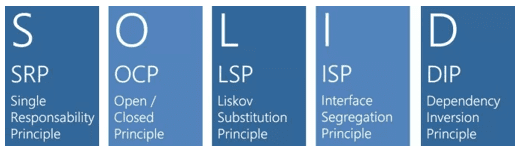
According to Martin (2008), Robert c. Martin identified five principles of object-oriented programming that seek the improvement of codes, such principles are SRP, OCP, LSP, ISP and DIP. Before these principles, Michael Feathers noted that could be created the acronym called SOLID containing the five principles. The following image demonstrates the meaning of the acronym:
Follows the definition of each part of the acronym according to the publication of Martin (2008):
When applying the SOLID, you get the following benefits to your project: facility to perform maintenance and project developments, ease of automated testing, less effort to code development and maximum reuse of code.
3. Proposed new collection System
The purpose of this article is to provide the knowledge base for the development of new software for management of the collection held by the Superintendency of the Manaus free trade zone-Suframa using the paradigm of object-oriented programming by applying the standards of DDD and SOLID projects in developing the project.
In this proposal, following a plan of action based on 5W1H administration model, we would have the following planning for further development:
Table 01-action plan for development of the new system.
| What to do? | Why? | How? | Where? | Who? | When? |
| Define programming language and technologies for the project | Standardize software development. | Technical meetings | On coordination of Informatics | ICT managers, programmers and software architects | First week |
| Preparing the development environment and approval | Create mechanisms for the team to work on the project | Installation of servers, software and frameworks | On the workstation of the members of the development team and on the servers. | Configuration and support team of ICT | Second week |
| Software requirements gathering | Document the information to be programmed in the field | Meetings and interviews | Suframa | Requirements analysts | The week 10 week 3. |
| Encoding | Create the software | Coding and testing | On Suframa | Software Factory | Of the week 22 week 11. |
| Approval and corrections | Find out if what has been developed is really what the Suframa needs and perform corrections | Performing tests | Approval environment | Domain experts (business) | Of the week 23 to 25. |
| Deployment | Make the system in the production | Doing the build in the production environment | Hosting systems | Configuration analyst | Week 26. |
Source: Drawn by the author.
As the table above, it appears that the project will take around six and a half months to complete, however it should be noted that this plan of action contains macros, actions would be needed other plans to detail every action in your macro execution.
In view of the action of "coding" pointed on 01 table, the use of DDD, this proposal recommends be created the following layers:
In all the layers should be applied the principles of SOLID.
Conclusion
This technical article sought to simply draw up a concrete proposal of migration from a legacy system in low platform development for a modern platform using as a base the standards of Software development projects oriented to development Domain (DDD) and SOLID.
It is understood that this proposal serves as the basis not only for the collection of the Superintendency of the Manaus free zone, but also as the basis for other projects of migration and evolution of software running in open for further adjustments and future re-issues by other authors.
References
Beck, Kent. "Patterns of implementation". Bookman. 2013. 168 p. ISBN 8565837971.
Gamma, Erich. "Design patterns". Bookman. 2000. 528p. ISBN 8573076100.
Evans, Eric. "Domain Driven Design 3rd Edition". High Books. 2016. 528p. ISBN 8550800651.
Martin, Robert. Clean Code: A Handbook of Agile Software Craftsmanship ". Prentice Hall PTR. 431p. ISBN 0132350882.
Available at: <http: cieam.com.br/?u="suframa-tenta-retomar-cobranca-da-taxa-de-servicos-administrativos_-suspensa-pelo-stf">accessed on 21 April 2017.</http:>
Available at: <http: www.eduardopires.net.br/2012/06/ddd-tdd-bdd/="">accessed on 21 April 2017.</http:>
Available at: <http: www.eduardopires.net.br/2016/08/ddd-nao-e-arquitetura-em-camadas/="">accessed on 21 April 2017.</http:>
Available at: <http: www.agileandart.com/2010/07/16/ddd-introducao-a-domain-driven-design/="">accessed on 21 April 2017.</http:>
[1] Graduated in computer science, it acts as a public server on SUFRAMA, as Administrative Analyst-you. Database specialist for ULBRA.
[2] Graduated in computer science, it acts as a public server on SUFRAMA, as Administrative Analyst-you.
[3] Graduated in computer science, it acts as a public server on SUFRAMA, as Administrative Analyst-you.
[4] Graduated in computer science, it acts as a public server on SUFRAMA, as Administrative Analyst-you.
[5] Graduated in computer science, it acts as a public server on SUFRAMA, as Administrative Analyst-you.
[6] Graduated in computer science, acts as server SUFRAMA, as Administrative Analyst-you.
[7] Graduated in computer science, acts as server SUFRAMA, as Administrative Analyst-you.
[8] Graduated in business administration, acts as public servant on SUFRAMA, as administrator.
[9] Graduated in economics, acts as public servant on SUFRAMA, as an economist.
In Papillary Thyroid Carcinoma (PTC), the BRAFV600E mutation represents 90% of cases, considered a point…
Introduction: Osteoporosis and cardiovascular diseases are frequent diseases, with high morbidity and mortality, and occur…
Introduction: Hepatocellular Carcinoma (HCC) is a primary liver neoplasm and the fastest-growing cause of cancer-related…
Background: Kombucha is the fastest growing product in the beverage market and one of the…
This study was conducted in two public squares in the city of Rio de Janeiro:…
This paper presents a historical and technical analysis of the development of software based on…